
Local Law 11 (FISP) Repairs Contractors In New York
Request An Estimate
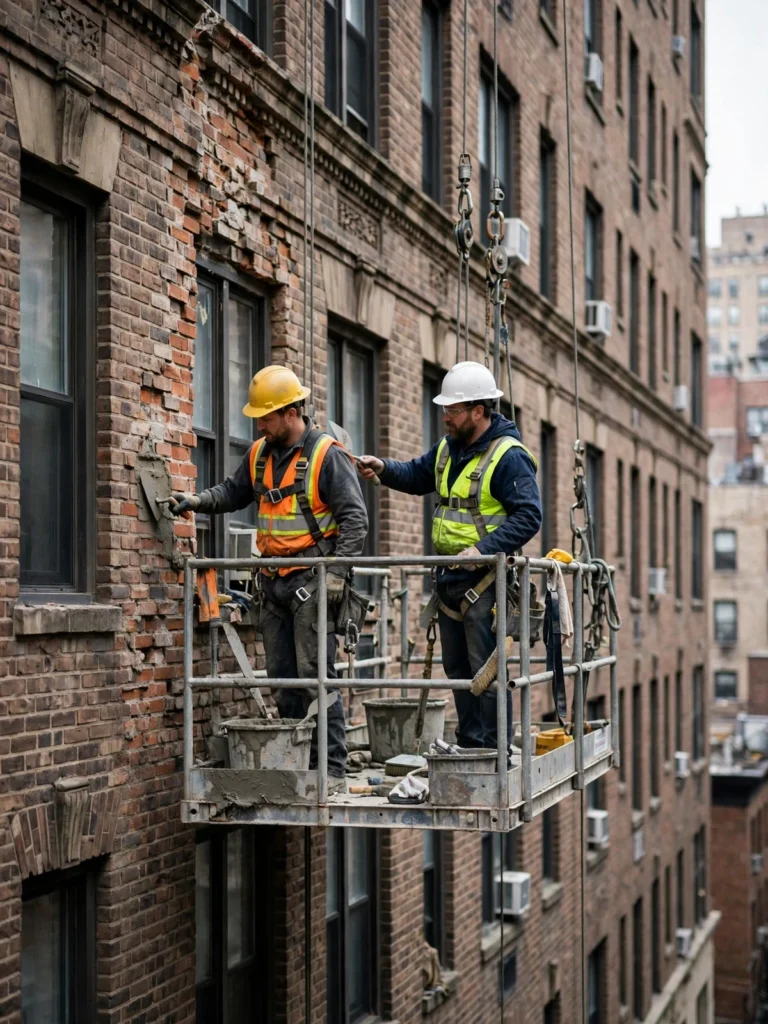
About Our Local Law 11 (FISP) Repair Services
A FISP report is a repair scope written by somebody else — our work starts by translating it. Condition by condition, elevation by elevation, we read what your QEWI recorded: the cracked and spalling masonry, the corroded lintels and shelf angles, the open joints and failed sealant, the balcony and parapet conditions, and the rating attached to each — because the rating sets the clock. Under current DOB rules, generally speaking, conditions rated Unsafe carry a short repair window, and SWARMP conditions carry a date set in the report by which they must be corrected before they become Unsafe. The priced scope follows that order: Unsafe first, SWARMP by its date, and the access planned so the building is rigged once for the whole programme rather than paid for twice.
The repairs themselves are the trades behind this page. Masonry conditions are executed with the craft depth set out on our masonry contractors page; parapet conditions run under our parapet wall repair scope; balcony conditions are repaired as assemblies under our balcony and terrace repair discipline; and conditions marked structural are priced and executed with the honesty that scope demands — including when an engineer’s direction must come first. As each condition is closed, it is documented — photographs, a work log, material records — and that documentation goes to your QEWI, whose re-inspection and amended filing close the cycle. We do not file it, sign it or rate it: the filing is the QEWI’s, and this page keeps that line bright on purpose.
What Is Local Law 11 (FISP)?
Local Law 11 of 1998 — administered today as the Facade Inspection Safety Program, FISP — is New York City’s facade-safety law. In general terms, it applies to buildings taller than six stories: their exterior walls and appurtenances — balconies, parapets, railings, cornices — must be examined up close, on a five-year cycle, by a Qualified Exterior Wall Inspector, a licensed architect or engineer approved by the Department of Buildings and engaged by the building’s owner. The current cycle, Cycle 10, began in February 2025, and filing windows run by block number within it. The law exists because facades fail outward, over public streets, and the city’s answer is scheduled professional eyes on every tall facade.
The QEWI’s report rates what the examination finds. A facade is filed Safe; Safe With A Repair and Maintenance Program — SWARMP, meaning conditions that must be corrected by a date the QEWI sets before they deteriorate into hazards; or Unsafe, meaning conditions that are dangerous now and carry a short window for repair and protective measures. Each rating obliges the owner to act; none of them is carried out by the inspector. The repairs, the documentation and the return to Safe are where a contractor belongs in the story — which is the whole of this page.
- Our Services
Types Of Services We Offer

FISP Report Repairs — Condition Programmes
Every condition in your QEWI's report priced as its own line and executed in one sequenced programme — the repair side of Local Law 11, carried by the trades the conditions actually need.

Unsafe Condition Repairs
Conditions rated dangerous now, taken first: protection in place, repairs inside the window the rules set, and the documentation your QEWI needs to close them — stated as general guidance, worked to your report.

SWARMP Condition Repairs
Safe today, on the QEWI's deadline: SWARMP conditions corrected by their set date, scheduled early in the programme — while they are still the cheapest version of the repair.

Masonry & Concrete Condition Repairs
The report's staple conditions — cracked and spalling masonry, open joints, deteriorated concrete — repaired at craft depth, elevation by elevation, exactly as listed.

Balcony & Parapet Condition Repairs
Appurtenances are examined and reported by name, and they are repaired the same way: balcony assemblies and parapet conditions executed as their own scopes inside the programme.

Repair Documentation For Your QEWI
Photographs, work logs and material records for every closed condition, assembled as the work proceeds and handed to your QEWI for the re-inspection and amended filing.

Structural Repairs From Your Report
Where a report lists structural conditions — corroded steel, spalling slab edges, movement cracks — the mechanisms and repair depth live on our structural repairs page.

Facade Repair & Restoration Programmes
The same hands, the other trigger: condition-driven restoration of a whole elevation for any building in our scale, inspection report or not.
Searching for Local Law 11 Repair Contractors Near Me?
If you hold a FISP report with conditions in it and you are searching for a contractor to carry them out, the distinction on this page is the one that matters: the professional who inspects and files is yours to engage, and the contractor who repairs should never pretend otherwise. RT General Construction Inc is based in Yonkers and carries out Local Law 11 repairs on buildings across Manhattan, the Bronx and Queens — the boroughs where the law applies — pricing each report condition by condition and sequencing the programme around its deadlines. Every building is read in person first, report in hand, elevation by elevation, and the written scope separates Unsafe work, SWARMP work and the access each needs, with the documentation your QEWI will require named in advance. The repair crafts sit behind this page — facade repair and restoration programmes, structural repairs for report-listed structural conditions — within our wider exterior repair and renovation service. Call us or send the form on this page to arrange a free estimate at your building.

- Why Choose Us
The Repair Contractor Behind Your QEWI's Report
- Repairs Only — Stated In The First Paragraph
- Every Condition Priced As Its Own Line
- Ratings Set The Running Order
- Rigged Once, Not Three Times
- Documentation Built For The Amended Filing
- Every Condition's Trade Behind One Scope
We Never Sign Or Rate A Facade
Deadlines Read From Your Report
Small And Mid-Sized Buildings, Taken Seriously
- Our Process
Process, How we Works.
01
An Unsafe Rating
Conditions dangerous now: loose or cracked material that could fall, failed elements over public ways. Under current rules these carry the shortest clock — protection first, repairs inside the window, as general guidance.
02
A SWARMP Rating
Safe today, on a deadline: the QEWI has set the date by which these conditions must be corrected before they become Unsafe. SWARMP work scheduled early is the cheapest version of this repair there is.
03
The Same Condition On Several Elevations
One cracked lintel is a repair; the same corrosion at every floor is a pattern, and patterns are priced as programmes — rigged once, not discovered floor by floor.
04
Appurtenances Listed By Name
Balconies, parapets, railings and cornices examined and reported individually. Each is its own repair assembly with its own craft — and its own line in the scope you should receive.
- Benefits
Benefits Of Hiring Us In New York
A FISP report is a deadline with a drawing attached. Here is what a repair contractor who knows his lane gets you.
The Report Priced Condition By Condition
Every listed condition read at the building and priced as its own line — no programme lump sum you cannot audit against your QEWI’s report.
Deadlines Driving The Sequence
Unsafe conditions first, SWARMP by its set date, access rigged once — the programme is built around the clocks in your report, not our convenience.
Documentation Your QEWI Can File Behind
Photographs, work logs and material records for every closed condition, handed to your QEWI for the re-inspection and amended filing that return the building to Safe.
The Line Kept Bright
We never inspect, rate, sign or file. That boundary is stated before you hire us — which is exactly why boards and owners can trust the repair side we do stand behind.
- Our Projects
Proven Quality, Best Results

- Testimonials
Built on Trust, Proven By Testimonials
98% Clients Are Positive Reviews 1 2


 Trustindex verifies that the original source of the review is Google.
 Trustindex verifies that the original source of the review is Google.
 Trustindex verifies that the original source of the review is Google.
 Trustindex verifies that the original source of the review is Google.
- Our Faq
Clear Answers to Your Construction Questions
What Do Local Law 11 Repairs Cost In New York?
Cost turns on the number and type of conditions your report lists, the mix between Unsafe and SWARMP items, the access the elevations need and how long a shed or scaffold must stand, the materials the repairs involve, and the documentation your QEWI requires to close each condition. A report with three joint conditions and a report with structural steel work are different programmes wearing the same letterhead. We read the report at the building and price the written scope condition by condition, so every figure traces back to a line your QEWI wrote.
SWARMP Vs Unsafe — What Is The Difference, And What Are The Deadlines?
As general guidance under current DOB rules: an Unsafe rating means conditions that are a danger now — they generally require prompt protective measures and repair within a short window set by the rules, followed by an amended filing. SWARMP — Safe With A Repair and Maintenance Program — means the facade is safe today but carries conditions your QEWI judges will become hazardous if left; the report sets a date by which they must be corrected. Treat this as general information, not advice about your building: your report and your QEWI state your actual obligations and dates.
Do You Perform The FISP Inspection Or File The Report?
No — plainly and by design. Inspections, condition ratings, and the technical and amended reports are performed, signed and filed only by a Qualified Exterior Wall Inspector — a DOB-approved licensed architect or engineer engaged by the building owner. We are not a QEWI and we claim no filing role. Our work begins where the report ends: pricing the conditions, carrying out the repairs, and documenting them so your QEWI can re-inspect and file the amended report that closes the cycle.
What Happens After The Repairs Are Finished?
As a general sequence: your QEWI re-inspects the repaired conditions, and if the work satisfies the report’s requirements, the QEWI files an amended report returning the facade to Safe; public protection then comes down and the cycle closes until the next one. Our part of that sequence is the completed repairs plus the documentation pack — photographs, logs and material records — delivered to your QEWI. How long the close-out takes depends on the number of conditions and your QEWI’s process; the scope we write names what we owe that process before work begins.
Which Buildings Does Local Law 11 Apply To?
Generally, New York City buildings taller than six stories, whose facades and appurtenances must be examined on a five-year cycle under FISP; the current cycle, Cycle 10, began in February 2025, with filing windows staggered by block number. Buildings of six stories or fewer are outside the law — though their facades fail by the same physics, which is why our facade repair and restoration page exists for them. Treat this as general guidance; your building’s status is a question your QEWI or the DOB records answer definitively.
- Services Areas
Proudly Serving Across New York
From interior renovations to exterior restoration, RT General Construction Inc delivers dependable construction and remodeling solutions for residential and commercial properties across New York. Our team handles everything from masonry, concrete, roofing, and exterior repairs to kitchens, bathrooms, painting, and interior improvements.
- New York
- Jerome Park, NY
- Village of Pelham, NY
- Harlem, NY
- Eastchester, NY
- North Side, NY
- Yonkers, NY
- New Rochelle, NY
- Pelham Manor, NY
- Mamaroneck, NY
- Larchmont, NY
- Tuckahoe, NY
- Hastings-on-Hudson, NY
- Scarsdale, NY
- Bronxville, NY
- White Plains, NY
- Manhattan, NY
- Astoria, NY
- Long Island City, NY
- Fresh Meadows, NY
- Flushing, NY
- Bayside, NY
- Queens, NY
Let's Build Something Amazing Together
Tell us about your project and we will arrange an assessment, explain what the work involves and provide a written scope before anything begins. One contractor, one plan, one accountable team — that is how RT General Construction Inc runs every job, large or small.